Documentation
Crawl4AI or Lightpanda?
A practical choice between Searchbase's two fetch workers.
Which should I choose?
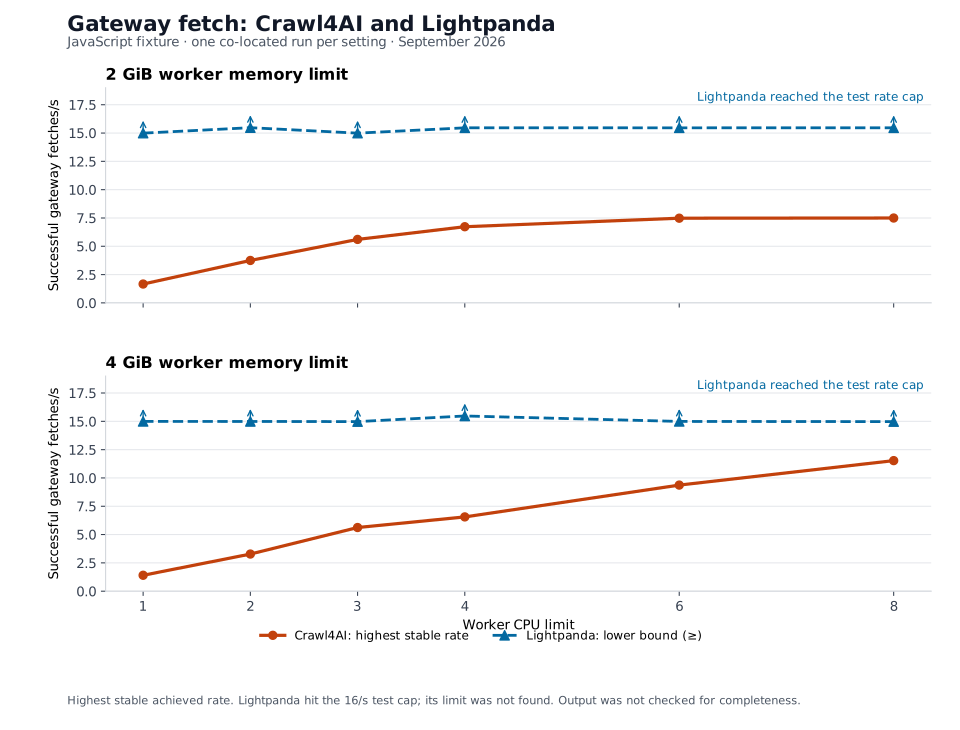
Pick the worker that best fits your deployment. At 4 worker CPUs / 2 GiB, the gateway completed at least 15.46
fetches/s with Lightpanda at the test ceiling, versus 6.73 with Crawl4AI.
The run used an older Lightpanda build and does not establish production
capacity. Crawl4AI remains the default and supports control over JavaScript
through js_render; Lightpanda always runs JavaScript.
The previously reported Lightpanda Markdown omission has been resolved and is not a current user-facing limitation. Markdown fidelity and token efficiency remain internal areas for regression testing and future optimization.
What did the saved test show?
At 4 worker CPUs and a 2 GiB worker limit, fetching the same local JavaScript page:
These saved results used the previous pinned nightly build. The current
0.4.1 release image has not been benchmarked here.
| Path | Crawl4AI | Lightpanda |
|---|---|---|
Gateway POST /api/v1/fetch | 6.73 successful fetches/s | ≥15.46 successful fetches/s; test capped at 16/s |
Direct worker POST /extract | 7.48 HTTP 2xx responses/s | ≥29.96 HTTP 2xx responses/s; test capped at 32/s |
The gateway result is the better basis for a choice: the gateway checks the
worker’s success flag. The older direct-worker test counted HTTP 2xx without
checking that flag, so its ~30/s figure is response throughput, not verified
successful extraction. A separate 2 CPU / 2 GiB Lightpanda cell reached
30.94 HTTP 2xx responses/s under the same 32/s target. Crawl4AI did exceed
8/s in larger configurations; for example, its 8 CPU / 2 GiB direct-worker
cell reached 9.37 HTTP 2xx responses/s.
Lightpanda reached the rate cap in every gateway cell plotted below. This means its actual maximum was not measured. The runs used one shared host, one deterministic page, one run per setting, and short discovery stages. They do not establish production capacity or content equivalence.
To rerun the tests on your hardware, see Load testing.